Clean FRCS notes with inline figures
•XR of this skeletally immature patient showing broken Shenton's and dislocated left hip
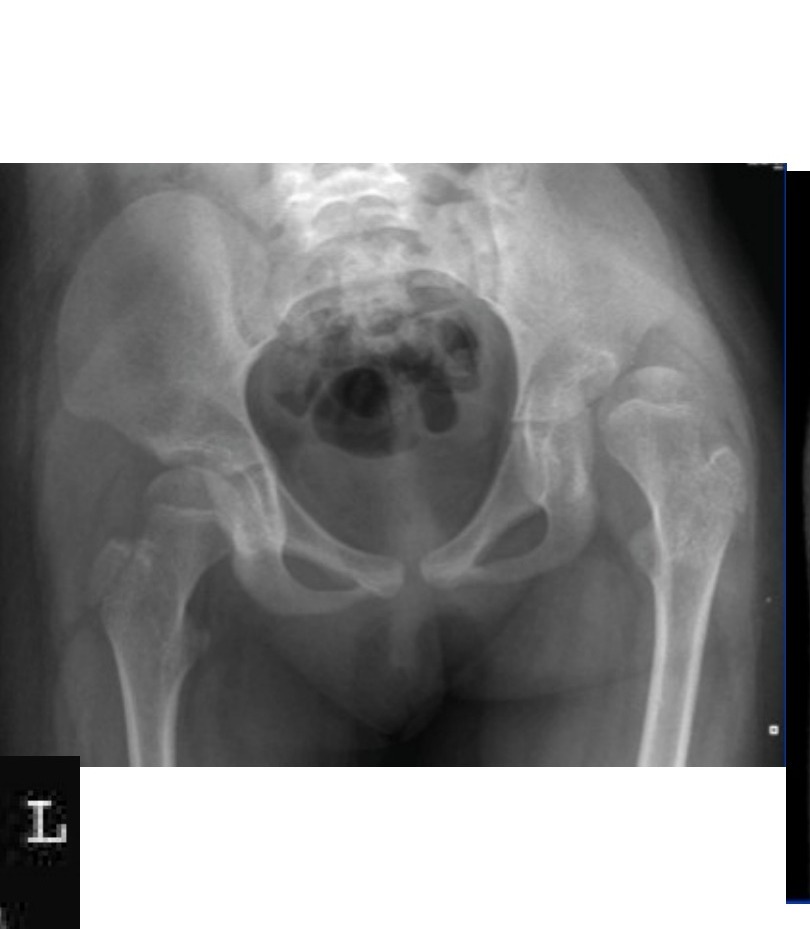
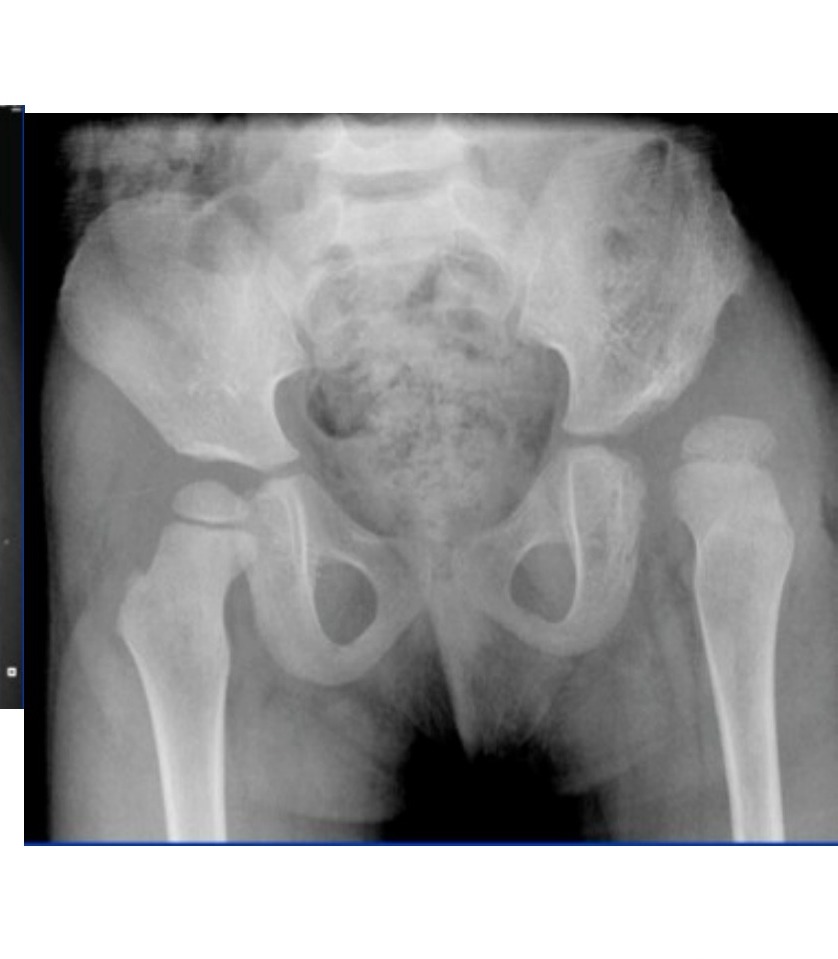
•The acetabular index is increased, and the neck shaft angle is also increased with perhaps more anteversion noted
•Reimer migration index (RMI) is increased
•I suspect this is a neuromuscular dislocation rather than DDH as evidenced by the relatively well formed tear drop and femoral head. Also pelvis looks inlet view due to pelvic anteversion from tight rectus
•Look for VP drain
•Triradiate cartilage fuses at 11-13yo
History
Perinatal history + Birth history
•Developmental milestone (age of sitting and walking)
•Problems faced by patient him/herself
•Problems faced by carer (perineal hygiene, pain, transfer, sitting)
•Determine GMFCS level (I no restriction II stairs rails III wheelchair IV powered wheelchair V self mobility limited
•Other medical problems
•Social support
•GMFCS 3 walker, 4 sitter
•If still very young, try to prognosticate if walker or not
•Good prognosis: head control by 9mo, sit by 2 yr, hemiplegic
•Bad prognosis: Persistent primitive reflex >1yo (Bleck), lack of head control by 20 months, non ambulatory by 7 yr
Examination
•General
•IQ
•Sitting balance
•Gait – assess stance and swing phase
•Orthosis
•Specific
•Hip tone, ROM, Thomas or Staheli test for FFC, adductor tightness by Phelps test, rectus tightness by Duncan Ely, ITB by Ober
•Knee tone, ROM, popliteal angle (hamstring shift is more accurate to see if psoas contracture is contributing)
•Ankle tone, ROM, silverskiold test, any bony impingement or impending ulcers
•Spine for scoliosis
•Pelvic obliquity
•LLD
•If non-ambulatory and >1yo, perform primitive reflexes, 2 or more is poor prognosis for walking according to Bleck
•Gait analysis lab for quantitative measurements
Management
•Multi-disciplinary approach (Paed, NS, Ortho, PT, Occu, P&O, MSW, family)
•Expectation management: Ortho has role only in spastic type, not able to reverse the primary insult
•Community-based, minimize hospital admissions
•Aims: maximize patient’s function consistent with the current disease status and prevent deterioration
Patient specific aims
•Walker – want to achieve an efficient gait, as described by Gage (stability in stance phase, adequate stride length, proper preposition of foot for heel strike, enough foot clearance, energy conservation) + prevent early OA
•Sitter – Spinopelvic balance, perineal hygiene, mobile knees (flex to sit, extend to brace for transfer), plantigrade feet
Medical management of spasticity
•- Physio, analgesia, wheelchair modification
•- Oral or intrathecal baclofen
•- Botox injection (3-6 months)
Surgery:
•Timing: delay OT as long as possible (>6yo), but before tertiary issue (contain hip before dislocation, gait modification before deviation)
•SEMLS (Single event multilevel surgery) vs OSSCS [orthopaedic selective spasticity control surgery = correct lever arm dysfunction by releasing or lengthening the biarticular muscles and preserving the monoarticular antigravity muscles]
•Prevent birthday syndrome
•Components
•Balance spasticity
•Prevent contractures
•Correct lever arm dysfunction
•Hip dysplasia in CP is preventable
•Spastic, bi-articular (adductor) more spasm than mono articular (abductor) → hip out
Treatment
•Conservative + Surveillance (Xray before 3 y.o. repeat one in 6 y.o. If walker, refer ortho if abd <30, or RMI >33%)
•According to the NICE guidelines and the Swedish CPUP study
•Reimer migration index, hip abduction
Early subluxation (RMI 33-50%):
•Botox / soft tissue release by adductor tenotomy, iliopsoas lengthening +/- hamstring lengthening, nighttime abduction splint
•(adductor longus transect, protect anterior branch of obturator nerve, gracilis myotomy, adductor brevis lengthening
•Moderate subluxation (RMI>50%)
Surgery – VDRO / pelvic osteotomy
•Dislocation
Surgery – recon vs salvage
•Depends on time
•Early <1yr: recon (OR + soft tissue release + VDRO +/- shortening osteotomy +/- pelvic osteotomy: dega or triple osteotomy)
•Late >1yr: observe if no pain, if pain, salvage, Girdlestone, capsule interpositional arthroplasty, McHale procedure (subtrochanteric valgus osteotomy + femoral head excision)
So we operate if the patient has dislocated hip but asymptomatic?
•Evidence suggests that less than 50% of asymptomatic dislocated hips will develop pain in the long run. As such, observation of asymptomatic hip can be supported
Why increased anteversion and valgus?
•Psoas spastic, hip flexed, reduced torque on proximal femur, femur cannot derotate, so anteversion. Valgus as non weight bearing
Follow-up
•Valgus ok
•But don’t understand anteversion
Cerebral Palsy:
•A neuromuscular disorder caused by non progressive insult to the immature brain. Primary neurological insult is non progressive but musculoskeletal features evolve as the child grows
Classification
•Topographically: Diplegic [bil LL more affected than bil UL], hemiplegic, quadriplegic
•Neurologically (5): spastic, hypotonic, mixed, athetoid (dyskinetic), ataxic
•Functionally: GMFCS (I – free ambulatory, II – rails with stairs, III – walking aid/ wheelchair, IV – head control, V no head control)
Issues:
•Primary deviation: loss of selective motor control, leading to muscle balance, abnormal tone and coordination
•Secondary deviation: growth related deviation that arise due to abnormal loading in the setting of primary gait deviations
•Anatomic shortening of muscle tendon unit (e.g. myostatic contractures)
•Persistent bone deformities due to HV principle (e.g. femoral anteversion)
•Joint subluxations/ dislocations
•Tertiary: compensatory deformities, become apparent when secondary is corrected
•Spasticity – velocity dependent increase in tone (due to loss of supraspinal inhibition)
•Measured with Tardieu scale (R1 R2 with different velocity)
Treatment: Global vs focal
•Global
•Selective dorsal rhizotomy (decrease afferent input from muscle spindle)
•Baclofen (GABA agonist → increase K channel opening → easy hyperpolarization)
•Gabapentin (VGCC deactivator → decrease nerve excitation and decrease neurotransmitter release)
•Focal: Botox
•Contracture – shortening of musculotendinous unit (due to slowing of growth due to lack of tensile loading) – Treatment: muscle (release or transfer), joint (release), bone (osteotomy)
•Lever arm dysfunction
•Unstable fulcrum (hip dislocation)
•Floppy lever (pes planus)
•Short lever (coxa valga)
•Malrotation (tibial ER)
Winter classification of CP gaits
•Hemiplegic gaits
•Foot drop → hinged AFO/ solid AFO
•True equinus - Gastroc soleus contracture → hinged AFO → heel cord lengthening
•Jump knee – Spastic hamstring + triceps surae → hinged AFO → no OT
•Apparent equinus – Iliopsoas contracture + gastroc weakness → solid AFO → psoas lengthening
•Diplegic gaits
•True equinus
•Jump knee
•Apparent equinus
•Crouch knee
•Recurvatum knee
•Stiff knee (swing phase problem)