FRCS Paediatric Ortho — improved notes
FRCS Paediatric Ortho — visual inline notes

110. Poliovirus – non-enveloped single-stranded RNA virus, a picornavirus and enterovirus

visual-inline rebuild1 extracted figuresspeaker notes XML59 study lines3 Q&A

Individual slide images have been cropped from the rendered slide and inserted beside the matching note section. The full slide remains below only for layout/audit.

Clean FRCS notes with inline figures

•Poliovirus – non-enveloped single-stranded RNA virus, a picornavirus and enterovirus
•Disease caused by poliovirus infection → destruction of ant horn cell in spinal cord and brain stem motor nuclei
•faecal-oral route, major [meningitis, encephalitis] and minor [flu like] type
•Poliomyelitis: Non progressive asymmetrical motor paralysis with sensory sparing

4 Phases:

•Acute – prodromal flu like, muscle painful, joints flexed
•Paralysis – after 2-3 days; limbs weak, swallowing/breathing affected; end 7-10 days
•Recovery – within 6 months
•Residual – residual paralysis (LMN, flaccid) with intact sensation → (with time) → deformity and growth disturbance
•Vaccination: 1958: First general use of Sabin (live attenuated vaccine) by mouth (OPV), Salk = inactivated polio vaccine (IPV)
•Post polio syndrome
•Aging phenomenon where the remaining neurons degenerate after working extra hard to compensate for the damaged neurons
•NOT reactivation
•Up to 50%
•Exercise at sub exhaustion levels to tone affected muscle groups + period of rest + light weighted caliper
•(PACING, maintain but not overuse)

Usually 2 scenarios:

•New sx after a period of convalescence i.e. post polio syndrome

Chronic problem of:

•Weakness/ Flail joint
•Deformity (due to posture, muscle imbalance, gravity)
•OA
•LLD
•Vascular dysfunction
•Assessment for 1. = rule out post polio syndrome, rule out other causes (medical, ortho, neuro)

Assessment for 2.
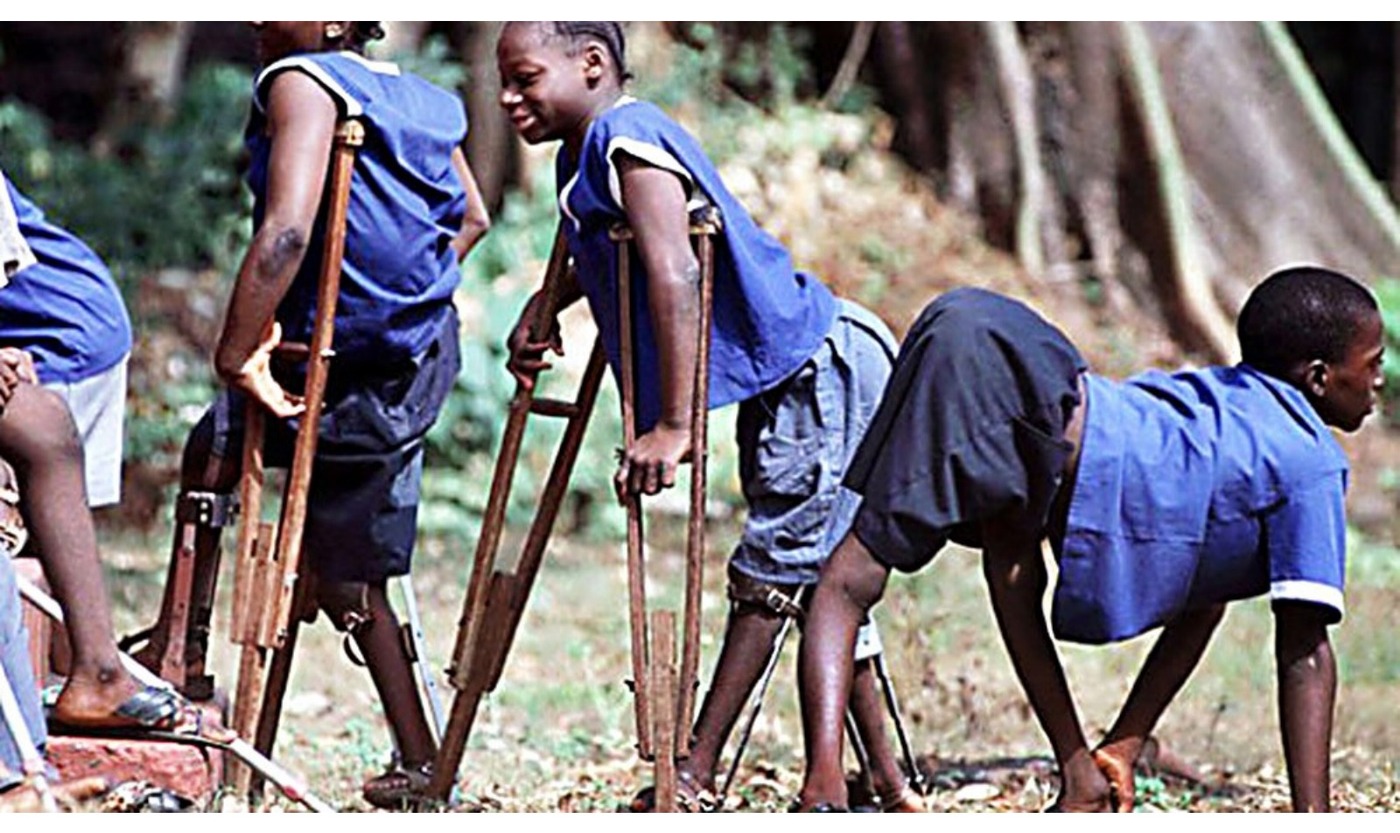
Clinical photograph
Fig 1. Clinical photographtop left
•Look at the following and treat accordingly
•Hip
•FABER contracture (Ober procedure, Campbell procedure)
•Trendelenberg gait (EO transfer, iliopsoas to GT)
•Dislocation
•Glut max weakness (glut max lurching gait)
•Knee
•Quads weakness (hand knee gait) (KAFO)
•FFC (serial casting, soft tissue release, extension osteotomy)
•Recurvatum (triple tenodesis)
•Flail knee (Fusion, KAFO)
•F&A
•Foot drop gait + circumduction gait
•Cavovarus, equinovarus
•LLD (short limb gait)
•Spine + pelvis – determine if pelvic obliquity is infra, supra or combined causes

IT band is the culprit for lots of presentations:

•Increased lumbar lordosis
•Pelvic obliquity
•FABER hip
•Knee FFC + valgus
•LLD
•Tibial ER
•Secondary F&A problems
•Most common weakness is at the quads
•2 adaptive mechanisms to bring the CG in front of the knee for passive standing/ stance phase
•Weak quads → knee flexion → CG behind knee causing flexion moment at knee
•To compensate, hip flexion to bring CG forward, ankle plantar flexion (ankle plantarflexion knee extension couple)
•Weak quads → knee recurvatum so ITB acts as extensor, CG now in front of knee. Counterbalanced by glut max and ankle dorsiflexor
•Weakness (from most common to least)
•LL: TibAnt, quads, glut max, gastroc
•UL: Deltoid, biceps, opponens

Direct Q&A

Q1 What diagnostic or radiographic findings support Poliovirus – non-enveloped single-stranded RNA virus, a picornavirus and enterovirus?
•Poliovirus – non-enveloped single-stranded RNA virus, a picornavirus and enterovirus
•Disease caused by poliovirus infection → destruction of ant horn cell in spinal cord and brain stem motor nuclei
•faecal-oral route, major [meningitis, encephalitis] and minor [flu like] type
•Poliomyelitis: Non progressive asymmetrical motor paralysis with sensory sparing

4 Phases:

•Acute – prodromal flu like, muscle painful, joints flexed
•Paralysis – after 2-3 days; limbs weak, swallowing/breathing affected; end 7-10 days
•Recovery – within 6 months
•Residual – residual paralysis (LMN, flaccid) with intact sensation → (with time) → deformity and growth disturbance
•Vaccination: 1958: First general use of Sabin (live attenuated vaccine) by mouth (OPV), Salk = inactivated polio vaccine (IPV)
Q2 What assessment points are listed for Poliovirus – non-enveloped single-stranded RNA virus, a picornavirus and enterovirus?

Look at the following and treat accordingly

•Hip
•FABER contracture (Ober procedure, Campbell procedure)
•Trendelenberg gait (EO transfer, iliopsoas to GT)
•Dislocation
•Glut max weakness (glut max lurching gait)
•Knee
•Quads weakness (hand knee gait) (KAFO)
•FFC (serial casting, soft tissue release, extension osteotomy)
•Recurvatum (triple tenodesis)
•Flail knee (Fusion, KAFO)
•F&A
•Foot drop gait + circumduction gait
•Cavovarus, equinovarus
•LLD (short limb gait)
•Spine + pelvis – determine if pelvic obliquity is infra, supra or combined causes
Q3 How is Poliovirus – non-enveloped single-stranded RNA virus, a picornavirus and enterovirus managed?
•Acute – prodromal flu like, muscle painful, joints flexed
•Paralysis – after 2-3 days; limbs weak, swallowing/breathing affected; end 7-10 days
•Recovery – within 6 months
•Residual – residual paralysis (LMN, flaccid) with intact sensation → (with time) → deformity and growth disturbance
•Vaccination: 1958: First general use of Sabin (live attenuated vaccine) by mouth (OPV), Salk = inactivated polio vaccine (IPV)
•Post polio syndrome
•Aging phenomenon where the remaining neurons degenerate after working extra hard to compensate for the damaged neurons
•NOT reactivation
•Up to 50%
•Exercise at sub exhaustion levels to tone affected muscle groups + period of rest + light weighted caliper
•(PACING, maintain but not overuse)

Usually 2 scenarios:

•New sx after a period of convalescence i.e. post polio syndrome

Chronic problem of:

•Weakness/ Flail joint

Raw speaker-note hierarchy audit

#lvlmarLindentlogicaloriginal note line
10NoneNone0Poliovirus – non-enveloped single-stranded RNA virus, a picornavirus and enterovirus
20NoneNone0Disease caused by poliovirus infection → destruction of ant horn cell in spinal cord and brain stem motor nuclei
30NoneNone0faecal-oral route, major [meningitis, encephalitis] and minor [flu like] type
40NoneNone0Poliomyelitis: Non progressive asymmetrical motor paralysis with sensory sparing
50NoneNone04 Phases:
60171450-1714501Acute – prodromal flu like, muscle painful, joints flexed
70171450-1714501Paralysis – after 2-3 days; limbs weak, swallowing/breathing affected; end 7-10 days
80171450-1714501Recovery – within 6 months
90171450-1714501Residual – residual paralysis (LMN, flaccid) with intact sensation → (with time) → deformity and growth disturbance
100NoneNone0Vaccination: 1958: First general use of Sabin (live attenuated vaccine) by mouth (OPV), Salk = inactivated polio vaccine (IPV)
110NoneNone0Post polio syndrome
120171450-1714501Aging phenomenon where the remaining neurons degenerate after working extra hard to compensate for the damaged neurons
130171450-1714501NOT reactivation
140171450-1714501Up to 50%
150171450-1714501Exercise at sub exhaustion levels to tone affected muscle groups + period of rest + light weighted caliper
160000(PACING, maintain but not overuse)
170000=========================================
180000Usually 2 scenarios:
190228600-2286001New sx after a period of convalescence i.e. post polio syndrome
200228600-2286001Chronic problem of:
210228600-2286001Weakness/ Flail joint
220228600-2286001Deformity (due to posture, muscle imbalance, gravity)
230228600-2286001OA
240228600-2286001LLD
250228600-2286001Vascular dysfunction
260000Assessment for 1. = rule out post polio syndrome, rule out other causes (medical, ortho, neuro)
270000Assessment for 2.
280000Look at the following and treat accordingly
290228600-2286001Hip
301685800-2286002FABER contracture (Ober procedure, Campbell procedure)
311685800-2286002Trendelenberg gait (EO transfer, iliopsoas to GT)
321685800-2286002Dislocation
331685800-2286002Glut max weakness (glut max lurching gait)
340228600-2286001Knee
351685800-2286002Quads weakness (hand knee gait) (KAFO)
361685800-2286002FFC (serial casting, soft tissue release, extension osteotomy)
371685800-2286002Recurvatum (triple tenodesis)
381685800-2286002Flail knee (Fusion, KAFO)
390228600-2286001F&A
401685800-2286002Foot drop gait + circumduction gait
411685800-2286002Cavovarus, equinovarus
420228600-2286001LLD (short limb gait)
430228600-2286001Spine + pelvis – determine if pelvic obliquity is infra, supra or combined causes
440000IT band is the culprit for lots of presentations:
450228600-2286001Increased lumbar lordosis
460228600-2286001Pelvic obliquity
470228600-2286001FABER hip
480228600-2286001Knee FFC + valgus
490228600-2286001LLD
500228600-2286001Tibial ER
510228600-2286001Secondary F&A problems
520000Most common weakness is at the quads
5300002 adaptive mechanisms to bring the CG in front of the knee for passive standing/ stance phase
540171450-1714501Weak quads → knee flexion → CG behind knee causing flexion moment at knee
550171450-1714501To compensate, hip flexion to bring CG forward, ankle plantar flexion (ankle plantarflexion knee extension couple)
560171450-1714501Weak quads -> knee recurvatum so ITB acts as extensor, CG now in front of knee. Counterbalanced by glut max and ankle dorsiflexor
570000Weakness (from most common to least)
580000LL: TibAnt, quads, glut max, gastroc
590000UL: Deltoid, biceps, opponens

Improved semantic hierarchy used for the study notes

#semantic levelsection?rewritten line
10Poliovirus – non-enveloped single-stranded RNA virus, a picornavirus and enterovirus
21Disease caused by poliovirus infection → destruction of ant horn cell in spinal cord and brain stem motor nuclei
31faecal-oral route, major [meningitis, encephalitis] and minor [flu like] type
41Poliomyelitis: Non progressive asymmetrical motor paralysis with sensory sparing
50yes4 Phases:
61Acute – prodromal flu like, muscle painful, joints flexed
71Paralysis – after 2-3 days; limbs weak, swallowing/breathing affected; end 7-10 days
81Recovery – within 6 months
91Residual – residual paralysis (LMN, flaccid) with intact sensation → (with time) → deformity and growth disturbance
101Vaccination: 1958: First general use of Sabin (live attenuated vaccine) by mouth (OPV), Salk = inactivated polio vaccine (IPV)
111Post polio syndrome
121Aging phenomenon where the remaining neurons degenerate after working extra hard to compensate for the damaged neurons
131NOT reactivation
141Up to 50%
151Exercise at sub exhaustion levels to tone affected muscle groups + period of rest + light weighted caliper
161(PACING, maintain but not overuse)
170——
180yesUsually 2 scenarios:
191New sx after a period of convalescence i.e. post polio syndrome
200yesChronic problem of:
211Weakness/ Flail joint
221Deformity (due to posture, muscle imbalance, gravity)
231OA
241LLD
251Vascular dysfunction
261Assessment for 1. = rule out post polio syndrome, rule out other causes (medical, ortho, neuro)
270yesAssessment for 2.
281Look at the following and treat accordingly
291Hip
302FABER contracture (Ober procedure, Campbell procedure)
312Trendelenberg gait (EO transfer, iliopsoas to GT)
322Dislocation
332Glut max weakness (glut max lurching gait)
341Knee
352Quads weakness (hand knee gait) (KAFO)
362FFC (serial casting, soft tissue release, extension osteotomy)
372Recurvatum (triple tenodesis)
382Flail knee (Fusion, KAFO)
391F&A
402Foot drop gait + circumduction gait
412Cavovarus, equinovarus
421LLD (short limb gait)
431Spine + pelvis – determine if pelvic obliquity is infra, supra or combined causes
440yesIT band is the culprit for lots of presentations:
451Increased lumbar lordosis
461Pelvic obliquity
471FABER hip
481Knee FFC + valgus
491LLD
501Tibial ER
511Secondary F&A problems
521Most common weakness is at the quads
5312 adaptive mechanisms to bring the CG in front of the knee for passive standing/ stance phase
541Weak quads → knee flexion → CG behind knee causing flexion moment at knee
551To compensate, hip flexion to bring CG forward, ankle plantar flexion (ankle plantarflexion knee extension couple)
561Weak quads → knee recurvatum so ITB acts as extensor, CG now in front of knee. Counterbalanced by glut max and ankle dorsiflexor
571Weakness (from most common to least)
581LL: TibAnt, quads, glut max, gastroc
591UL: Deltoid, biceps, opponens